ContemporaryMetamorphosis of Odia Heritage
Traces of the Vanished, at Bikaner House, New Delhi, presents a profound visual commentary on Odisha’s disappearing cultural heritage. Seamlessly bridging classical folk traditions like Pattachitra with sophisticated contemporary techniques, the Puri-born artist utilizes fragmented colour planes and evocative mask imagery. This powerful body of work confronts regional loss, transforming fading ancestral memories into an enduring dialogue with modern artistic sensibilities.
In the landscape of contemporary Indian art, the tension between heritage and modernity often produces two distinct pathways: a rigid preservation of classical forms that resists temporal evolution, or a complete departure from cultural roots in pursuit of a globalized avant-garde syntax. Occasionally, however, an extraordinary practitioner emerges who refuses this false dichotomy. Subhendu Mishra (b. 1991), a visual artist hailing from the rural expanse of Puri, Odisha, represents
this rare, vital bridge. His major solo exhibition, *Lupta: Traces of the Vanished*—hosted at the LTC Gallery, Bikaner House, New Delhi —stands as a profound, visually arresting meditation on the fragile continuity of regional tradition under the crushing momentum of modernization. Mishra’s oeuvre does not merely mimic the past, nor does it flatly document disappearing aesthetics. Instead, it actively reconstructs a lost visual vocabulary through fragmented colour planes, layered compositions, and the haunting, symbolic recurrence of the mask. His practice functions as both a creative triumph and an act of socio-cultural responsibility, bringing global contemporary art sensibilities into a visceral, face-to-face dialogue with ancestral devotion.
Rooted in the Soil: The Creative Awakening of Birapratappur
To comprehend the structural depth of Mishra’s canvas, one must look to the geography of his upbringing. Mishra was born and raised in Birapratappur, a village situated within the Puri district of Odisha. This hamlet lies mere cycling distance from Raghurajpur, India’s world-renowned heritage village inhabited by hereditary *Pattachitra* masters. In this distinctive corner of rural Odisha, art is not compartmentalized as a leisure activity or an industry; it is the very atmosphere that conditions daily existence. From early childhood, Mishra was completely immersed in an environment where entire families revolved around the rhythmic preparation of canvases, the boiling of natural pigments, and the meticulous execution of sacred mural iconography. While his peers and siblings pursued traditional formal education, Mishra was possessed by an instinctive, almost obsessive affinity for draftsmanship. He spent his earliest years sketching figures on slate boards and replicating the fading, weather-beaten *Pattachitra* murals that adorned the walls of local homes. His commitment to this visual path was so intense that he resolved to become a master painter well before he had even learned the alphabet. This singular devotion came at the cost of his conventional academic progress. Finding formal secondary school profoundly uninspiring, Mishra attended classes only sporadically, arriving primarily to sit for his annual examinations. When he was eventually barred from advancing past the ninth standard due to a chronic lack of attendance, he walked away from the standard educational system entirely. Though his family was understandably taken aback by his uncompromising stance, his elder sister recognized the true nature of his rebellion. She introduced him to the existence of fine arts colleges—academic spaces entirely dedicated to the practice of painting. Ironically, the realization that an art degree required a formal school-leaving certificate became the exact motivation Mishra needed to temporarily return to his books and finish his basic schooling.
The Crucible of Academic Training: From Khallikote to Mumbai
Mishra’s entry into formal arts institutions marked Contemporary \Metamorphosis of Odia Heritage the beginning of a prolonged, dialectical confrontation between indigenous instincts and institutional expectations. He completed his Bachelor of Visual Arts in Painting at the historic Government College of Art & Crafts (G.C.A.C.) in Khallikote. The transition was initially jarring; the young artist, who expected a purely practice-driven environment, found the heavy theoretical components deeply daunting. Furthermore, during his initial years at Khallikote, his signature realistic draftsmanship did not align with the highly stylized, abstract tendencies favored by the prevailing institutional status quo. It was only during his third year of study that a perceptive instructor recognized the latent power of his raw, distinctive brushwork, offering the validation necessary to sustain his artistic confidence. Upon graduation, Mishra traveled to New Delhi with the hope of entering the Delhi College of Art. Though his admissions attempts there were unsuccessful, this brief urban residency exposed him to a new visual lexicon. Coming from a rural landscape where water was drawn directly from village wells, Mishra became deeply fascinated by the aggressive, labyrinthine networks of urban blue water pipes cutting across cityscapes—a motif he integrated into transient surrealist experiments during this period. The definitive turning point in his formal training occurred when he secured admission to the prestigious Sir J.J. School of Art in Mumbai to pursue a Master of Fine Arts (MFA) in Creative Painting . Mumbai provided a sprawling, cosmopolitan arena that challenged him to articulate his artistic identity on a national scale. However, the true catalyst for his mature style was an unexpected historical disruption: the onset of the COVID-19 pandemic and the subsequent nationwide lockdowns. Forced to leave the urban sprawl of Mumbai during his second year of post-graduation, Mishra returned to his native village . This forced homecoming allowed him to re-examine the *Pattachitra* and performance traditions of his childhood through a critically detached, highly sophisticated academic lens.
Reconstructing the Forgotten: Field Research and Materiality
Rather than succumbing to the isolation of the lockdown, Mishra weaponized this period to conduct exhaustive field research . He spent countless hours cycling through the villages of the Puri district, engaging in deep dialogues with master craftsmen, mask-makers, and traditional performance practitioners. Driven by a profound curiosity, he visited remote regional temples, local monasteries (*mathas*), and ancient ancestral households in search of old, forgotten *Pattachitra* works that predated commercialized tourist iterations. In these fading remnants, Mishra made a critical discovery: older traditional works possessed a raw graphic boldness, a striking sense of scale, and an emotional depth that had largely been replaced in contemporary commercial folk art by an over-refined, hyper-detailed, and mechanical delicacy. He became fascinated by the organic chemistry and durability of old natural pigments, meticulously studying how these mineral and botanical colours interact with light and surface over centuries. Mishra’s studio methodology is an unyielding extension of this research. His canvases are complex sites of material synthesis, utilizing natural pigments, acrylics, oils, wood, and palm-leaf engravings . By using traditional substrates like wood and palm leaves alongside modern canvas, he preserves an tactile, visceral connection to the earth . This synthesis allows him to anchor his work in regional materiality while simultaneously exploiting the elastic, scalable possibilities of contemporary experimental painting .
The Visual Vocabulary of *Lupta*: Masks, Myth, and Fragmentation
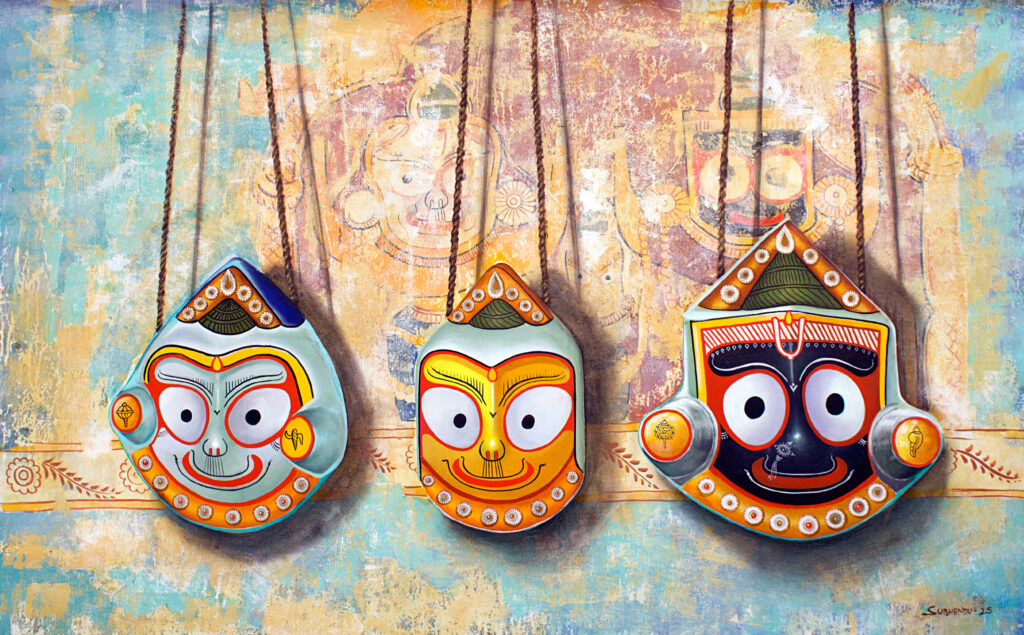
The conceptual core of *Lupta* lies in its engagement with the rich, performative tapestry of Shree Jagannatha culture, specifically the ritualistic street theater of *Puri Sahi Jata*, the vibrant dances of *Medha Nacha*, and the expressive grace of *Gotipua* . These ancient art forms carry centuries of communal memory and esoteric spiritual devotion, yet they find themselves on the precipice of extinction in an increasingly digital world.
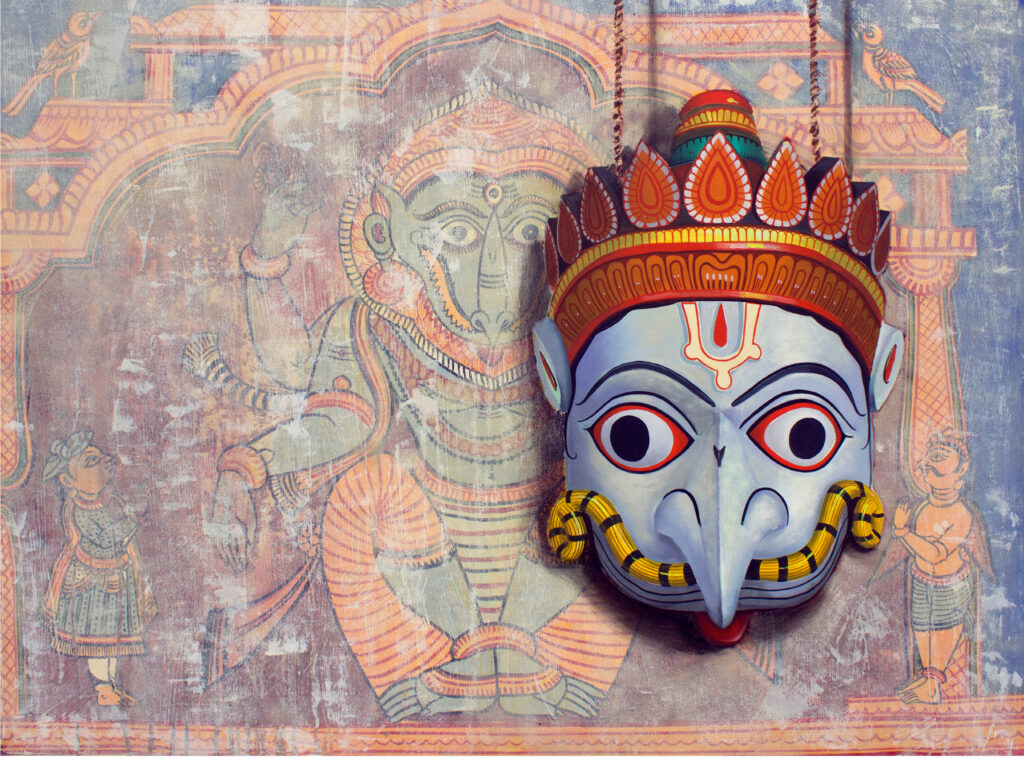
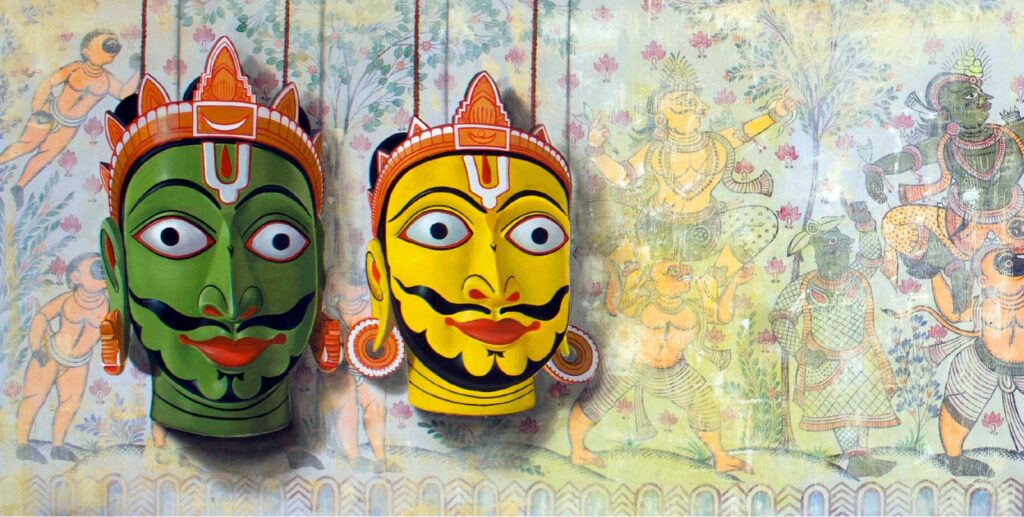
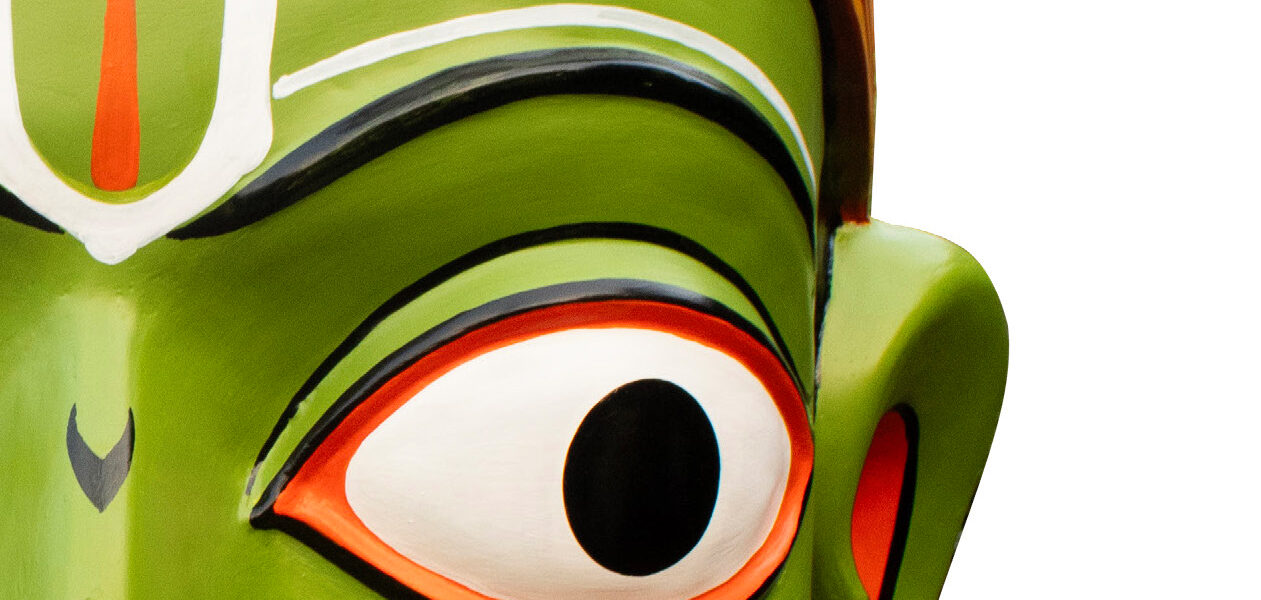
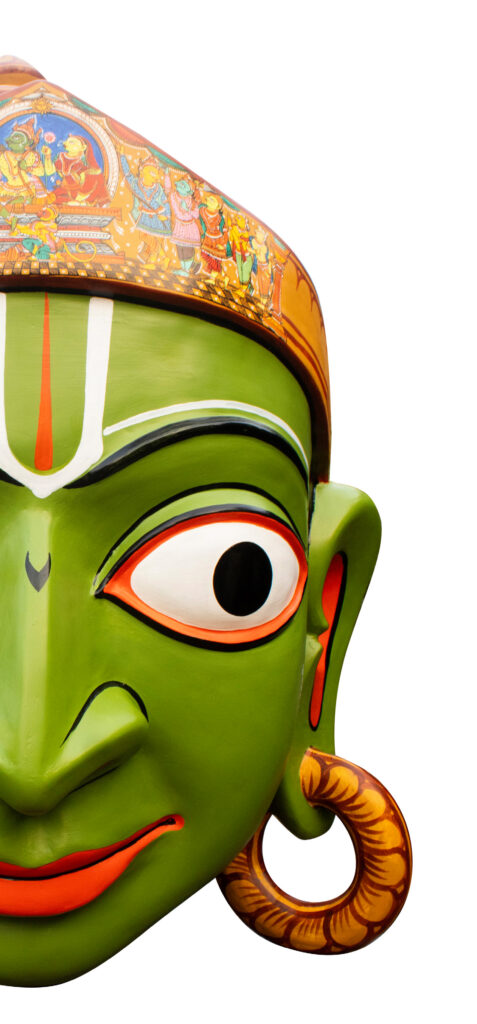
Mishra’s most significant creative breakthrough occurs through his masterful deconstruction of the traditional *Mukha* (mask craft). In works like *Lupta-101*, *Lupta-102*, and *Lupta-104*, he presents an innovative visual device: highly realistic, sculptural depictions of traditional theatrical masks suspended over complex, faded narrative backdrops. Rather than rendering a flat illustration of folklore, each painting functions as a layered psychological space. The mask stands forward as a vivid embodiment of a mythological character, while the surrounding, partially eroded imagery narrates fragmented episodes from the Puranas and epics, conveying both spiritual narratives and ethical philosophies.
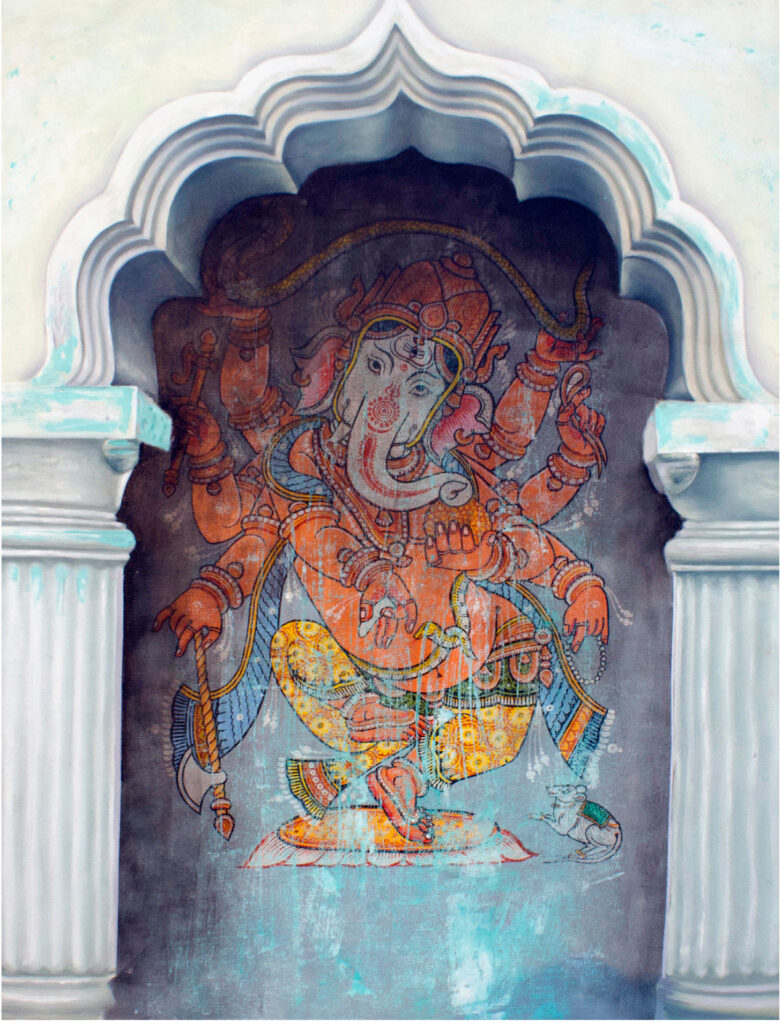
A defining formal characteristic of his work is his use of sophisticated colour fragmentation. The background planes do not present a continuous space; instead, they are broken into distressed, textured shards and geometric intervals that simulate the cracking of ancient temple walls or the fading of memory itself.
This technique serves a dual purpose. Aesthetically, it mirrors the language of mid-century modernist abstraction. Conceptually, it symbolizes the fracturing of cultural transmission. It invites the viewer to look past the immediate, seductive beauty of the mask and confront the reality of what is actively slipping away from our collective consciousness . This brilliant negotiation of forms was so striking that during his final academic evaluations, reviewers famously mistook his dimensional paintings for actual physical sculptures, transforming his once-critique-prone realism into an undisputed, career-defining strength .
Conclusion: A Landmark for Contemporary Indian Art
The critical and institutional response to Mishra’s vision confirms the cultural urgency of his project. Endorsed early on by prominent regional bodies such as the Ila Panda Centre for Arts (IPCA) in Bhubaneswar—which supported his academic path through an MFA scholarship—Mishra has gracefully transitioned from a promising young student to a powerful, singular voice in Indian contemporary art. As highlighted by acclaimed painter and scholar Bipin Martha, Mishra’s work stands as a triumphant manifestation of *”Odia Asmita”* (Odiya Identity), showing how regional heritage can be proudly articulated through a completely contemporary global vernacular.
By operating out of his newly established independent studio in his native village of Birapratappur, Subhendu Mishra refuses the typical rural-to-urban artistic migration. He remains embedded in the
community he seeks to advocate for, using a portion of his platform to bring vital attention to the economic hardships and dwindling livelihoods of traditional artisans. *Lupta: Traces of the Vanished* is far more than a stunning gallery exhibition; it is an enduring manifesto on cultural resilience. It proves that tradition is not a static museum artifact to be preserved in amber, but a living, breathing entity that, when handled with academic rigor and profound personal reverence, can adapt, transform, and continuously captivate the modern world.