DJ’s Constant EnergyA Three-Decade Odyssey from Mud Roots to Cubist Mastery
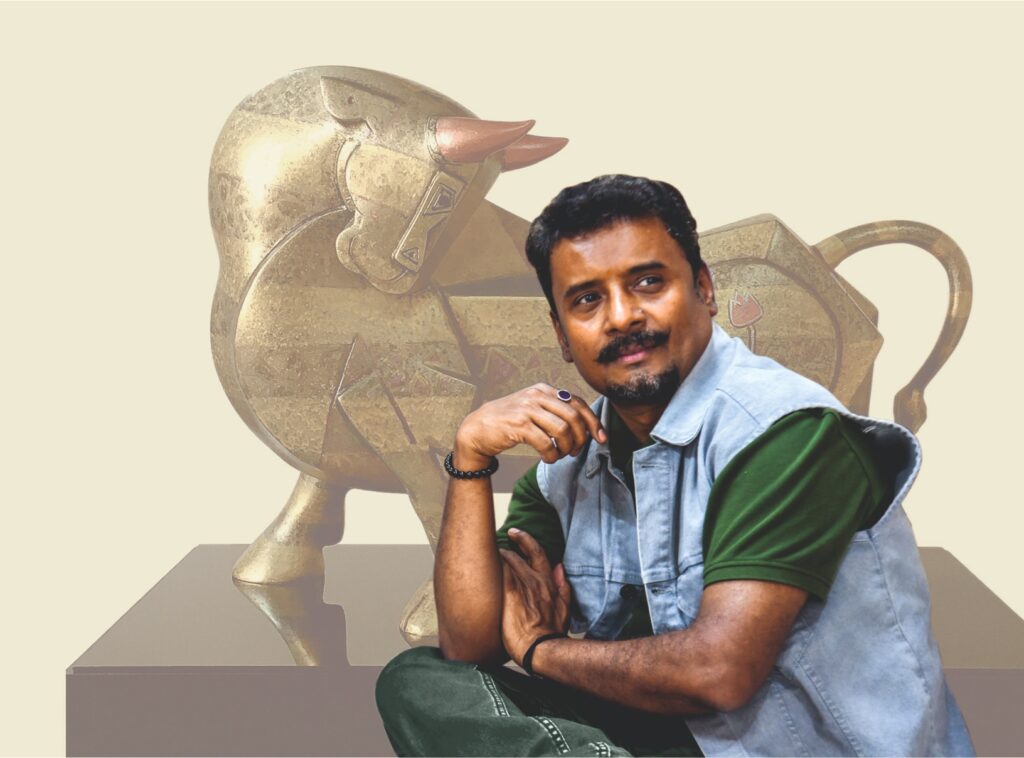
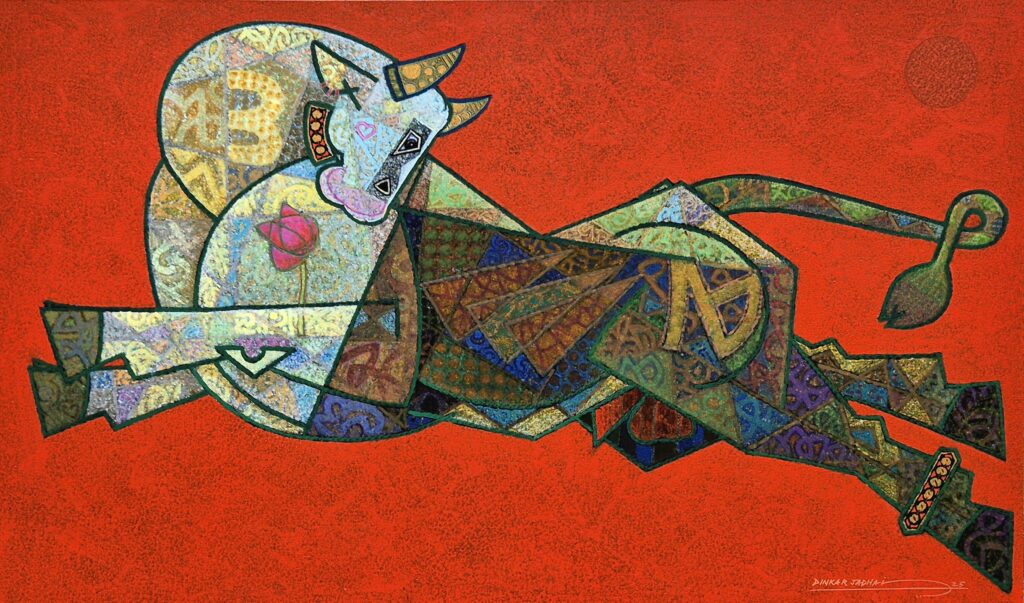
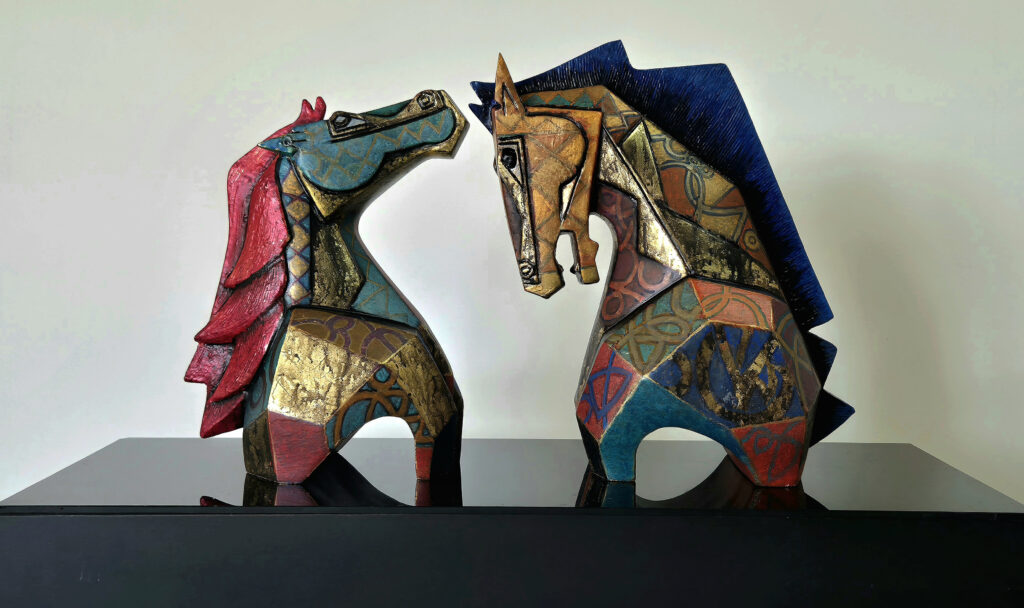
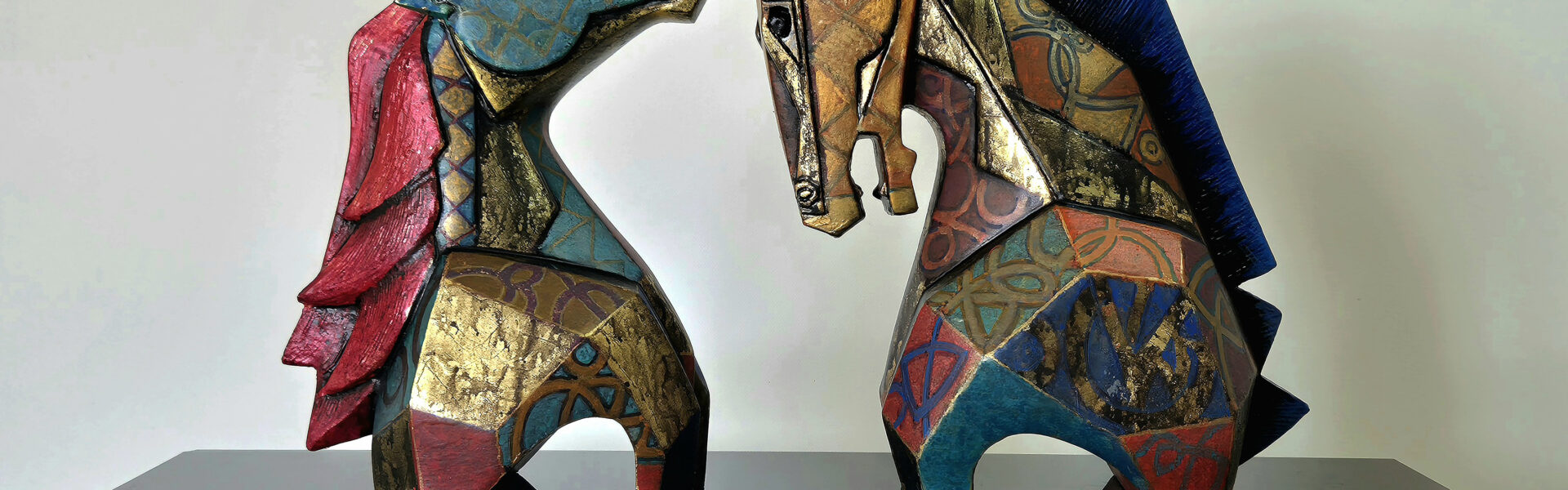
Dinkar Jadhav is a distinguished Indian artist from Jadhavwadi, Pune, whose 3 decade career is defined by the philosophy that energy is constant, merely changing form over time. A graduate of Abhinav Kala Mahavidyalaya, he is celebrated for his “realistic but not imitative” approach to nature. His signature style features bold, cubist geometry and a meticulous technique of layering of transparent tones to create vivid, smooth textures. Best known for his evocative Horse and Bull series, Jadhav captures kinetic movement and potential power in both acrylic canvases and dynamic fiberglass sculptures.
The Mud Roots: You’ve shared that your earliest “sculptures” were made of mud in your village as a child. How does the tactile memory of that mud influence the way you approach high-end fiberglass and bronze sculptures today?
Dinkar’s journey began with making mud toys, bulls, and temples as a child during village festivals. While he now uses high-end fiberglass and bronze, he views the transition as a natural evolution of energy. The “tactile memory” of hand-decorating bulls during the Bail Pola festival-where he would put his own thumb impressions on the animal’s body-is directly translated into his sculptures today. He seeks to ensure that even in 3D, the sculpture doesn’t look like a generic object but carries the same “vivid and smooth” hand-brushed texture found on his canvases.
The Turner Influence: Your early fascination with William Turner led you to create hundreds of landscapes in a single year. Looking back, how did Turner’s mastery of light and atmosphere evolve into your current signature “color-blocking” and impasto style?
Dinkar was so inspired by William Turner’s mastery of light that he created 500 watercolor landscapes in a single year during college. Over time, he moved away from Turner’s atmospheric realism to develop his own “realistic but not imitative” style. He realized that to capture the energy of light rather than just its appearance, he needed to break forms into boldly elegant blocks. His signature color-blocking is essentially a structured way to layer that Turner-esque light, using 12 to 15 transparent layers to create depth and atmosphere within geometric shapes.
The L’ap to Pune: Moving from a village of 30 huts to studying at Abhinav Kala Mahavidyalaya was a massive shift. What was the most challenging part of translating your rural observations into the formal language of contemporary art?
The shift from a village of 30 huts to Pune was massive, but Dinkar used it to bridge the gap between “folk” observation and “fine art” technique. The most challenging part was moving past simple replication. He supported himself by working on commercial Ganpati decorations and architectural murals, which stripped away his fear of large-scale work and taught him the “formal language” of building a composition. He eventually realized he didn’t want to paint what he saw in the village, but what he felt about it, leading to his unique “emotional map” style.
The Cubist Form: You are often called a master of cubist art. Why did you feel that breaking down subjects like horses and bulls into geometric shapes was the best realism?
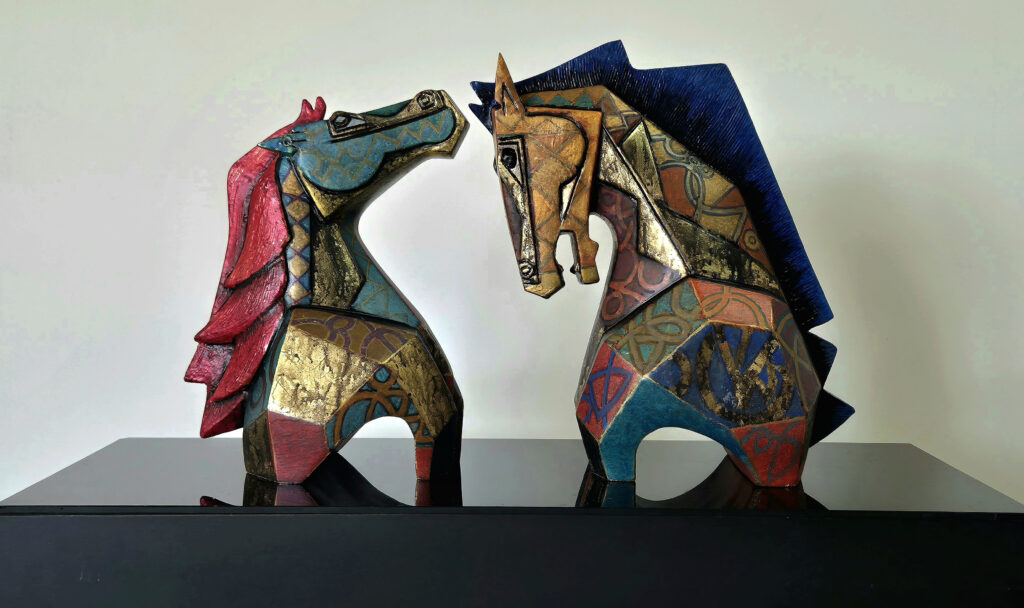
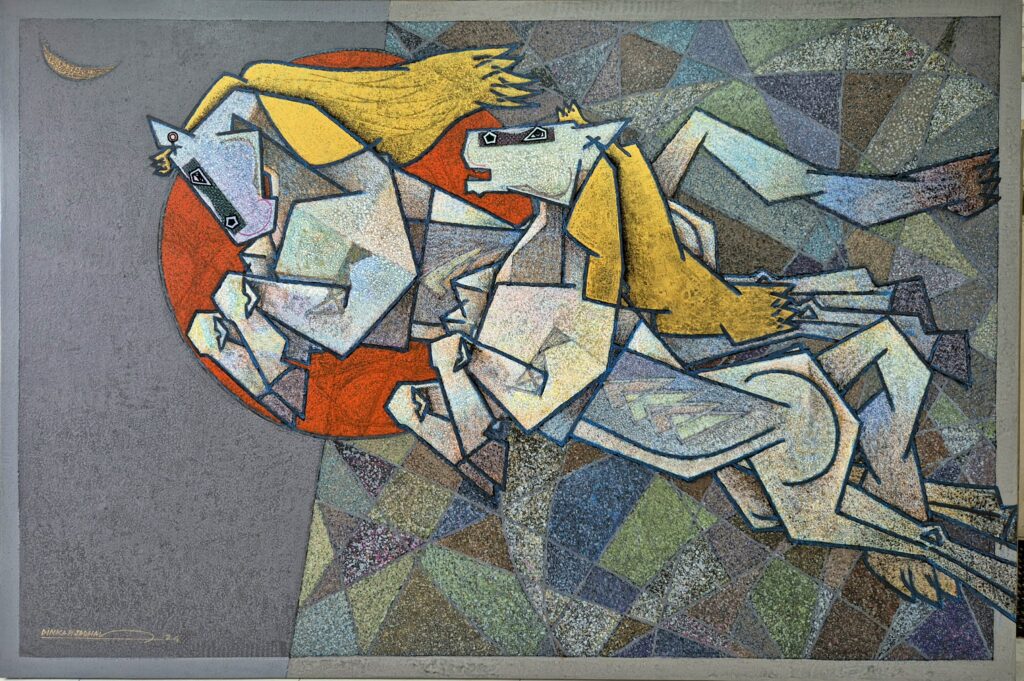
Dinkar believes that traditional realism can sometimes be “still,” whereas cubist geometry represents kinetic energy. By breaking a horse into triangles and sharp angles, he captures the “rhythm of hooves” and the “breath of equine life”. To him, the horse is kinetic energy (motion) and the bull is potential energy (power in stillness). Geometric shapes allow him to show both these forces simultaneously within a single frame.
Layering Energy: Your paintings often feature 10-12 layers of color. Could you walk us through the emotional process of building these layers? At what point do you feel a piece has achieved the “vibrancy” you’re looking for?
Building these layers is a meditative process. He avoids the “impasto” palette knife because it is too heavy; instead, he uses a brush to keep the texture vivid yet smooth.
n The Process: Each transparent layer “whispers its own emotion” onto the canvas.
n Achieving Vibrancy: He knows a piece has achieved the right vibrancy when the “inner energy” of the subject begins to reflect his own thoughts. He describes it as “churning ideas” until the final art emerges as a communication between his mind and heart.
Evolution of Emotion: Your work has shifted from themes of “anguish and fierce passion” in your early Ashwa Chitramala series to the “lust for love” and romance in your recent work. What personal or creative shift triggered this change in your palette and strokes?
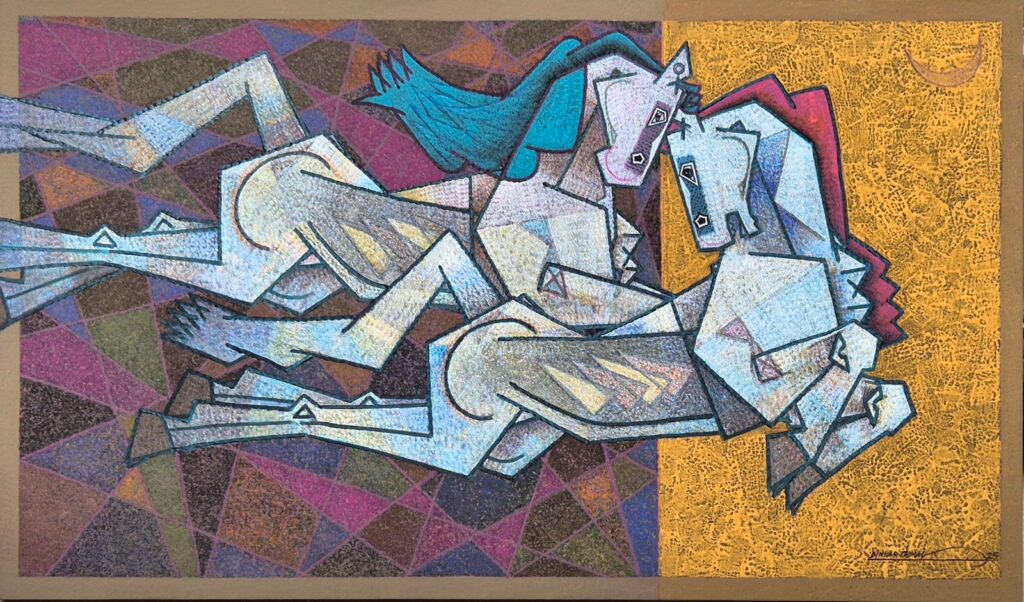
His early work often focused on the struggle and power of solitary animals. However, his recent “Lust for Love” series represents a creative shift toward companionship and romance. This was triggered by a desire to explore the “nuanced emotions” shared between male and female horses. His palette has shifted from fierce, clashing tones to a more harmonious use of different tones of the same color to create a sense of “soothing energy” and “peaceful journey”.
Symbolism of the Bull: While your horses represent freedom, your bulls represent virility and strength. What draws you specifically to the bull as a symbol for human ambition and the “charge” toward one’s dreams?
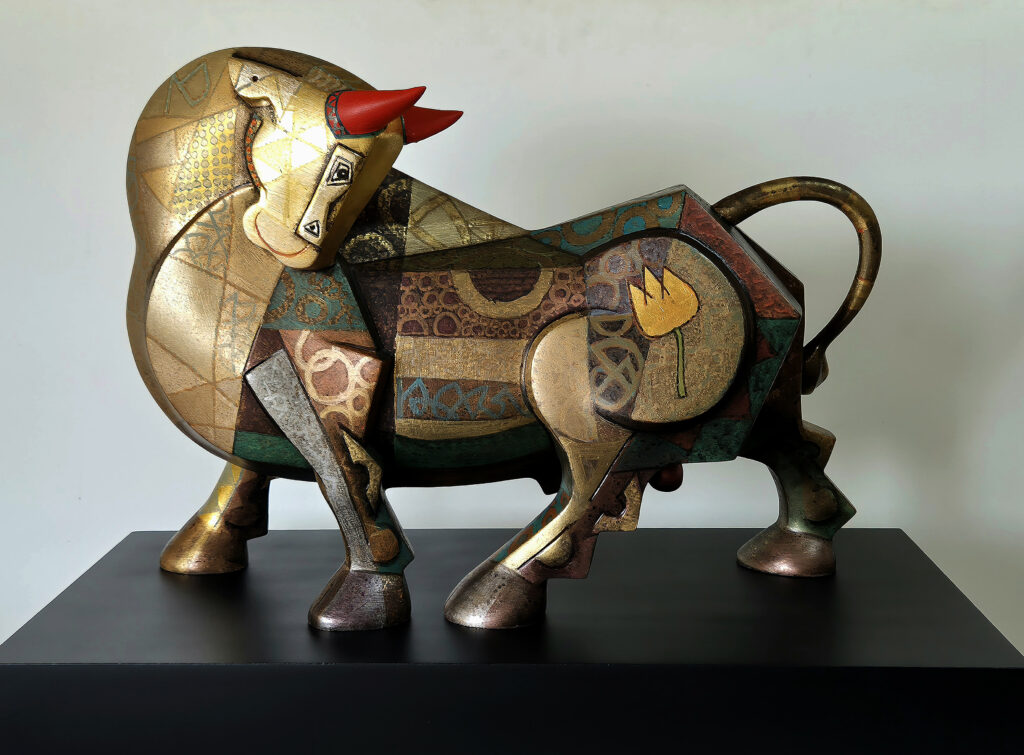
In Jadhav’s philosophy, the horse and the bull are symbols of positive power and strength, though they represent different states of energy. The horse is the personification of kinetic energy and freedom; to understand their nuances, Jadhav once took up residence in a horse stable to study their silence and sensitivity. Conversely, the bull represents potential energy-the massive power held in stillness-and serves as a symbol for human ambition and the “charge” toward one’s dreams. His depictions of bulls are deeply rooted in memories of the Pola festival, where the animals are celebrated as the prized possessions of farmers. In his recent compositions, he often utilizes a flat “breathing space” that occupies 30-40% of the canvas to contrast against busy cubist lines, representing the peace and sanctuary a couple finds within their own world.
The Power of Pairs: Many of your recent works feature horse couples. How do you use composition and color to differentiate the energy of a solitary animal versus the “timeless bond” of a pair?
Dinkar uses composition to differentiate these energies:
n Solitary: Focuses on the raw, kinetic power of the animal.
n Pairs: He often divides the canvas into two parts-one featuring complex cubist lines to represent the “bustle of the world,” and a “flat, plain” 30-40% area that represents the peace and sanctuary the couple finds in each other. This “breathing space” in the composition signifies their timeless bond.
Translating 2D to 3D: When you move from an acrylic canvas to a 3D sculpture, how do you maintain that “crayon-like texture” and cubist geometry in space?
This is his most difficult challenge. He doesn’t just want to “copy” the painting into a 3D form; he wants the sculpture to be a painting in space. He achieves this by applying the same transparent layering technique and hand-brushing to the fiberglass surface that he uses on canvas. This maintains the “Duco paint” finish and “crayon-like” crispness even on a 3D object.
The Choice of Medium: You work with bronze, gold foil, and fiberglass. How do you decide which material best suits a particular form-for instance, why choose the stillness of bronze for one bull and the vivid “Duco paint” finish of fiberglass for another?
Dinkar chooses his materials based on the “type” of energy he wants to project:
n Fiberglass: Used for his more “vibrant” and “emotional” stories, as it takes color beautifully and allows for the “Duco” high-gloss, multi-layered finish that mirrors his paintings.
n Bronze/Metal: He uses these for forms that require a sense of permanence and “potential energy”. For instance, a bull in bronze represents a “stillness” and “heaviness” that fiberglass cannot capture, emphasizing the animal’s ancient, grounded power.
Contemporary Artist Dinkar Jadhav recently had an in-depth conversation about his works with Shital Verma